Blog
Categories
Latest News


Contact Us
Room 1201.1122 Xinjinqiao Rd,Pudong new district, Shanghai PRC China
How Sludge Drying Systems Help Reduce Disposal Costs in Wastewater Treatment
Sludge disposal is one of the major operating costs for many municipal and industrial wastewater treatment plants. In most projects, the cost is not only related to the amount of sludge generated, but also to its moisture content, transport distance, storage conditions, and final disposal method.
This is why sludge drying has become an important part of modern sludge treatment systems. By reducing the water content in dewatered sludge, a sludge drying system can help lower sludge volume, reduce transportation frequency, improve storage efficiency, and create more flexible options for final disposal or resource recovery.
Why Moisture Content Matters
After mechanical dewatering, sludge still contains a high proportion of water. Even when the sludge cake appears solid, moisture remains a major part of its total weight. This means that wastewater treatment plants may still spend a significant amount of money transporting and disposing of water rather than dry solids.
Higher moisture content can lead to several challenges:
- Higher transportation and handling costs
- Larger storage space requirements
- More difficult long-distance transport
- Higher risk of odor and secondary pollution during storage
- Limited options for downstream disposal or reuse
For facilities that need to reduce long-term operating costs, further moisture reduction after dewatering can be an effective step.
How Sludge Drying Reduces Disposal Cost
A sludge drying system removes additional moisture from dewatered sludge through controlled heat transfer and air circulation. As the sludge becomes drier, its total weight and volume are reduced. This can directly reduce the cost of sludge transportation, storage, and final disposal.
For projects where sludge must be transported to landfills, incineration plants, cement kilns, or other treatment facilities, lower sludge weight can make a clear difference in operating expenses. In some applications, dried sludge may also support resource recovery routes, depending on local regulations, sludge composition, and final use requirements.
The main value of sludge drying is not only “drying the sludge,” but improving the economics of the whole sludge treatment chain.
Suitable Applications Across Industries
Sludge drying can be used in both municipal and industrial wastewater treatment projects. Typical application areas include:
- Municipal wastewater treatment plants
- Food and beverage processing plants
- Paper mills
- Chemical and industrial wastewater treatment plants
- Sludge treatment and disposal centers
- Projects requiring sludge volume reduction before transport or final disposal
Different industries have different sludge characteristics. For example, food processing sludge may contain oil, organic matter, or fibers, while municipal sludge may require stable long-term operation. Therefore, the drying system should be selected according to sludge source, inlet moisture content, target moisture level, daily treatment capacity, available energy conditions, and disposal route.
SFC Sludge Drying Solutions
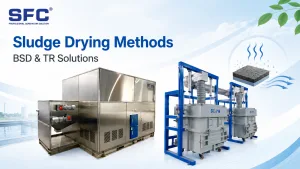
Shanghai Fuchan Machinery Technology Co., Ltd. (SFC) provides sludge treatment equipment for sludge thickening, dewatering, deep dewatering, drying, and supporting systems. For sludge drying applications, SFC offers equipment such as belt sludge drying systems and reciprocating circulation sludge drying systems, helping customers build more complete sludge reduction solutions.
SFC sludge drying systems are designed to support stable operation, controlled drying performance, and easier integration with upstream dewatering equipment. In a complete sludge treatment process, drying is often used after mechanical dewatering or deep dewatering to further reduce sludge moisture and improve disposal efficiency.
Supporting Sustainable Sludge Management
Reducing sludge volume can bring both economic and environmental value. Less sludge volume means fewer transport loads, lower storage pressure, and improved conditions for final disposal. When the dried sludge meets the requirements of downstream treatment or utilization, it may also support resource recovery opportunities.
For wastewater treatment plants and industrial facilities, sludge drying should be considered as part of the overall sludge management strategy rather than as a single piece of equipment. A well-designed sludge drying system can help reduce lifecycle costs, improve operational stability, and support more sustainable wastewater treatment across industries.