Blog
Categories
Latest News

Contact Us
Room 1201.1122 Xinjinqiao Rd,Pudong new district, Shanghai PRC China
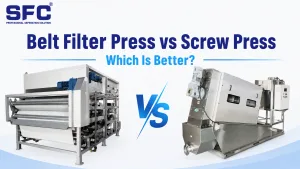
Belt Filter Press vs Screw Press: Which Sludge Dewatering Machine Is Better?
When selecting sludge dewatering equipment, many wastewater treatment plants compare two common options: the belt filter press and the screw press. Both machines are widely used in municipal and industrial sludge treatment, but they are designed for different operating conditions.
The better choice depends on sludge type, inlet concentration, treatment capacity, site layout, operation requirements, and final disposal target. In most projects, the question is not “which machine is always better,” but “which machine is more suitable for this sludge and this project.”
What Is a Belt Filter Press?
A belt filter press, also called a belt sludge dewatering machine, removes water from conditioned sludge through gravity drainage and mechanical pressing. After polymer dosing and flocculation, sludge is distributed onto the filter belt. Free water is first removed by gravity, and then the sludge passes through a pressing zone to form a sludge cake.
Belt filter presses are often selected for projects that require continuous operation and larger treatment capacity. They are commonly used in municipal wastewater treatment plants, food processing wastewater, paper mills, and other industrial sludge treatment applications.
SFC provides belt-type sludge dewatering equipment such as the GDY Series Belt Sludge Concentration and Dewatering Machine and FTE3 Series Belt Sludge Dewatering Machine. According to SFC product data, belt-type systems can be selected for different inlet sludge concentrations and medium-to-large treatment capacities, depending on sludge characteristics and operating conditions.
Advantages of Belt Filter Press
A belt filter press is usually suitable when the project requires higher throughput and continuous sludge handling. Its main advantages include:
- Suitable for medium and large sludge treatment capacity
- Continuous operation
- Good performance for many municipal and industrial sludge types
- Clear dewatering process with gravity drainage and pressing stages
- Suitable for integration with sludge thickening, polymer dosing, conveying, and drying systems
For projects with relatively stable sludge properties and sufficient installation space, a belt filter press can be a practical and efficient dewatering choice.
Limitations of Belt Filter Press
A belt filter press also has some requirements. It usually needs proper belt cleaning, sufficient water supply for washing, regular belt maintenance, and enough site space for installation and operation.
If the sludge is very sticky, oily, unstable, or difficult to flocculate, the performance of a belt filter press should be carefully evaluated through sludge testing. Polymer selection and dosing control are especially important for stable operation.
What Is a Screw Press?
A screw press sludge dewatering machine uses a screw shaft, fixed rings, moving rings, and a back pressure structure to complete sludge thickening and pressing. In the thickening section, filtrate is discharged through the gaps between rings. In the dewatering section, the internal volume gradually decreases, generating pressure to form and discharge sludge cake.
SFC’s DL Series Screw Sludge Dewatering Machine is designed for continuous sludge dewatering with a compact structure and self-cleaning operation. According to SFC product data, the DL series can be selected for inlet sludge concentrations generally around 0.4%–3.5%, depending on sludge characteristics and project conditions.
Advantages of Screw Press
Compared with many belt-type systems, a screw press is usually more compact and easier to operate. Its main advantages include:
- Small footprint
- Lower operating speed
- Lower energy consumption
- Self-cleaning structure
- No filter belt
- Simple daily operation
- Suitable for many low- and medium-capacity projects
For wastewater treatment plants with limited space, lower sludge flow, or a preference for simpler operation and lower maintenance, a screw press can be a suitable option.
SRD Wear-free Screw Press for Difficult Sludge
For more difficult sludge conditions, SFC also provides the SRD Wear-free Multi-disc Screw Press Sludge Dewatering Machine.
According to SFC’s 2026 product catalog, the SRD wear-free screw press uses a double screw shaft conveying structure. Two spiral shafts run side by side in the filtration chamber and help clean sludge from each other, reducing the risk of blockage. The movable rings are independently driven, so their movement is not restricted by screw shaft speed. This design helps improve filtration speed and reduce wear between the screw shaft and rings.
The SRD wear-free screw press is designed to address two common issues in conventional screw press operation: wear of key components and material clogging. It is especially suitable for sludge with low concentration, strong viscosity, oil content, or high inorganic content.
Limitations of Screw Press
A screw press is not always the best choice for every project. For very large sludge treatment capacity, a belt filter press or an integrated belt-type dewatering system may be more suitable. The final selection should also consider sludge concentration, dry solids load, polymer performance, cake moisture target, and downstream disposal route.
If the project requires very high throughput or a complete thickening and dewatering process in one continuous line, belt-type equipment may have advantages.
Belt Filter Press vs Screw Press: Key Comparison
| Comparison Point | Belt Filter Press | Screw Press |
|---|---|---|
| Typical strength | Higher capacity and continuous operation | Compact structure and low-maintenance operation |
| Suitable projects | Medium and large sludge treatment projects | Small to medium projects or limited-space sites |
| Sludge condition | Suitable for many stable municipal and industrial sludge types | Suitable for low-concentration and selected industrial sludge types |
| Maintenance focus | Filter belt cleaning and belt maintenance | Screw shaft, rings, and moving parts |
| Water use | Usually requires belt washing water | No filter belt washing requirement |
| Footprint | Usually larger | Usually smaller |
| Operation style | Continuous operation with belt and roller system | Continuous operation with screw press structure |
| SFC related equipment | GDY / FTE3 / Other belt-type dewatering systems | DL / SRD screw press systems |
Which Machine Is Better?
A belt filter press is usually better when the project needs larger treatment capacity, continuous operation, and enough installation space.
A screw press is usually better when the project requires compact layout, lower energy consumption, simpler operation, and lower maintenance demand.
For difficult sludge such as oily, sticky, low-concentration, or high-inorganic-content sludge, the SRD Wear-free Multi-disc Screw Press Sludge Dewatering Machine may be considered because it is designed to reduce wear and clogging problems.
How to Choose the Right Sludge Dewatering Machine
Before choosing between a belt filter press and a screw press, the following information should be reviewed:
- Sludge source and sludge characteristics
- Inlet solids concentration
- Daily sludge volume or dry solids load
- Operating hours
- Target cake moisture
- Polymer type and dosage
- Site layout and available space
- Water supply for cleaning
- Maintenance requirements
- Downstream drying, deep dewatering, or final disposal method
A correct selection should be based on sludge testing and engineering evaluation rather than equipment name alone.
SFC Sludge Dewatering Solutions
Shanghai Fuchan Machinery Technology Co., Ltd. (SFC) provides sludge dewatering equipment and integrated sludge treatment systems for municipal and industrial wastewater projects.
SFC’s sludge dewatering product range includesDL Series Screw Sludge Dewatering Machines, SRD Wear-free Multi-disc Screw Press Sludge Dewatering Machines, GDY Series Belt Sludge Concentration and Dewatering Machines, FTE3 Series Belt Sludge Dewatering Machines, FTB Series Rotary Drum Sludge Dewatering Machines, polymer preparation systems, sludge conveying systems, deep dewatering systems, and sludge drying equipment.
By reviewing sludge characteristics, treatment capacity, target cake moisture, and disposal requirements, SFC helps customers select a suitable sludge dewatering machine and build a practical sludge treatment process.
Conclusion
Belt filter press and screw press machines both play important roles in sludge dewatering. A belt filter press is often more suitable for larger capacity and continuous high-throughput projects, while a screw press is often preferred for compact layout, low energy consumption, and simpler maintenance.
The best choice depends on the sludge itself and the project conditions. For reliable sludge dewatering performance, equipment selection should always be based on actual sludge properties, process requirements, and long-term operating cost.