Blog
Categories
Latest News

Contact Us
Room 1201.1122 Xinjinqiao Rd,Pudong new district, Shanghai PRC China
How to Choose a Sludge Dewatering Machine: Complete Buyer Guide
Choosing the right sludge dewatering machine is critical for efficient wastewater treatment and long-term sludge management. A suitable machine can help reduce sludge volume, lower disposal pressure, improve operation stability, and support downstream drying, deep dewatering, or final disposal.
However, there is no single sludge dewatering machine that works best for every project. The correct choice depends on sludge characteristics, treatment capacity, target cake moisture, site conditions, operating cost, and maintenance requirements.
This guide explains the key factors buyers should review before selecting a sludge dewatering machine.
1. Understand the Sludge Type First
Sludge type is the first factor to check before equipment selection. Different sludge sources have different dewatering behavior.
Municipal sludge is usually more stable, but it still requires proper polymer conditioning and continuous operation control. Industrial sludge may be more complex. Food processing sludge may contain oil, organic matter, or fibers. Paper mill sludge may contain high fiber content. Mining sludge may contain more inorganic solids. Chemical sludge may require more careful testing before equipment selection.
Before choosing a sludge dewatering machine, buyers should collect basic sludge information, including:
- Sludge source
- Inlet solids concentration
- Organic or inorganic content
- Oil and grease content
- Fiber content
- Sludge viscosity
- Existing treatment process
- Final disposal method
If sludge properties are unclear, jar testing or pilot testing is recommended before final equipment selection.
2. Confirm Treatment Capacity
Treatment capacity should be calculated based on actual sludge volume and dry solids load, not only the total wastewater flow.
Important information includes daily sludge volume, operating hours per day, inlet solids concentration, and expected dry solids load. For example, a plant operating 8 hours per day and a plant operating 20 hours per day may need different equipment sizes even if the daily sludge volume is similar.
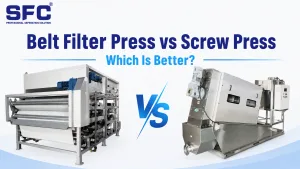
For larger continuous treatment projects, belt-type sludge dewatering equipment may be more suitable. For smaller or medium-capacity projects with limited space, a screw press may be a practical option.
3. Define the Target Cake Moisture
Different projects have different requirements for final sludge cake moisture. If the sludge is only transported to a nearby disposal site, standard mechanical dewatering may be enough. If transportation distance is long or disposal cost is high, the project may require deeper moisture reduction.
Common equipment options include:
- Mechanical dewatering for standard sludge volume reduction
- High-pressure deep dewatering for lower cake moisture
- Sludge drying for further volume and weight reduction
The target cake moisture should be discussed together with the final disposal route. A lower moisture target may reduce disposal cost, but it may also require higher equipment investment or additional process stages.
4. Compare Equipment Options
Several types of sludge dewatering machines are commonly used in municipal and industrial wastewater treatment projects.
Screw Press Sludge Dewatering Machine
A DL Series Screw Sludge Dewatering Machine is suitable for many sludge dewatering projects that require compact layout, continuous operation, low-speed running, and relatively simple maintenance. Its structure uses fixed rings, moving rings, and a screw shaft to complete thickening and pressing in one machine.
A screw press is often considered when the project has limited installation space, moderate treatment capacity, or a preference for low-maintenance operation.
SRD Wear-free Multi-disc Screw Press Sludge Dewatering Machine
For more difficult sludge conditions, the SRD Wear-free Multi-disc Screw Press Sludge Dewatering Machine can be considered.
The SRD wear-free screw press is designed to reduce two common problems in conventional screw press operation: key component wear and material clogging. It uses a double screw shaft conveying structure, where two spiral shafts run side by side in the filtration chamber and help clean sludge from each other.
This design is especially suitable for sludge with low concentration, strong viscosity, oil content, or high inorganic content.
Belt Sludge Dewatering Machine
A belt sludge dewatering machine is often suitable for projects requiring larger treatment capacity and continuous operation. Belt-type equipment removes water through gravity drainage and mechanical pressing.
SFC provides belt-type solutions such as the GDY Series Belt Sludge Concentration and Dewatering Machine and FTE3 Series Belt Sludge Dewatering Machine. These systems can be selected according to inlet concentration, treatment capacity, site layout, and downstream process requirements.
Rotary Drum Thickening and Dewatering Machine
A rotary drum sludge dewatering machine can combine sludge thickening and mechanical dewatering. It may be suitable for certain medium- or high-concentration sludge applications where thickening and dewatering need to be integrated in one process.
High-Pressure Deep Dewatering System
If standard mechanical dewatering cannot meet the moisture target, a high-pressure sludge deep dewatering system can be used as a secondary sludge reduction process. This option is often selected when transportation cost, disposal cost, or downstream drying requirements are more demanding.
5. Evaluate Operating Cost
The purchase price is only one part of the total cost. Buyers should also evaluate long-term operating cost.
Operating cost may include:
- Polymer consumption
- Power consumption
- Washing water consumption
- Spare parts
- Labor requirement
- Maintenance frequency
- Downtime risk
- Sludge transportation and disposal cost
A cheaper machine may not always reduce the total cost if it requires more maintenance, consumes more chemicals, or produces unstable sludge cake. A suitable sludge dewatering machine should be evaluated based on lifecycle cost, not only initial investment.
6. Check Site Conditions
Site layout can directly affect equipment selection. Before purchasing, buyers should confirm available space, installation height, foundation conditions, power supply, water supply, drainage connection, sludge feeding route, filtrate return route, and sludge cake discharge method.
For retrofit projects, compact equipment may be easier to install. For new wastewater treatment plants, the dewatering system can be planned together with sludge storage, polymer preparation, conveying, drying, and final disposal facilities.
7. Consider Downstream Treatment
Sludge dewatering should not be selected as an isolated unit. It should match the downstream sludge treatment route.
If the sludge will be dried, better dewatering performance can reduce the load on the dryer. If the sludge will be deeply dewatered, the primary dewatering stage should provide stable feed conditions. If the sludge will be transported directly, cake moisture, cake shape, and storage requirements become more important.
A complete sludge treatment process may include sludge thickening, polymer preparation, mechanical dewatering, deep dewatering, drying, conveying, storage, and final disposal.
8. Work with an Engineering Team
A reliable supplier should not only provide a machine model. It should help review sludge conditions, capacity requirements, target moisture, site layout, and operating cost before recommending equipment.
Shanghai Fuchan Machinery Technology Co., Ltd. (SFC) provides sludge dewatering equipment and integrated sludge treatment solutions for municipal and industrial wastewater projects. SFC’s product range includes DL Series Screw Sludge Dewatering Machines, SRD Wear-free Multi-disc Screw Press Sludge Dewatering Machines, GDY Series Belt Sludge Concentration and Dewatering Machines, FTE3 Series Belt Sludge Dewatering Machines, FTB Series Rotary Drum Sludge Dewatering Machines, high-pressure sludge deep dewatering systems, polymer preparation systems, sludge conveying systems, and sludge drying equipment.
By reviewing actual project conditions, SFC helps customers select a sludge dewatering solution that is practical, stable, and suitable for long-term operation.
Conclusion
Choosing a sludge dewatering machine requires more than comparing equipment names. Buyers should review sludge type, treatment capacity, target cake moisture, operating cost, site layout, and downstream disposal route.
A screw press may be suitable for compact layout and simpler operation. A belt sludge dewatering machine may be better for larger capacity and continuous treatment. For difficult sludge, the SRD wear-free screw press can be considered. For lower moisture targets, deep dewatering or drying may be added after primary dewatering.
The best sludge dewatering solution should match the real sludge characteristics and the long-term goals of the wastewater treatment project.