Blog
Categories
Latest News

Contact Us
Room 1201.1122 Xinjinqiao Rd,Pudong new district, Shanghai PRC China
Sludge Drying Methods: How to Reduce Sludge Volume Efficiently
Sludge drying is an important process used after mechanical dewatering to further reduce moisture content, sludge volume, transportation pressure, and final disposal cost. For municipal wastewater treatment plants and industrial wastewater facilities, drying is often considered when ordinary dewatering cannot meet disposal, storage, or resource recovery requirements.
In a complete sludge treatment system, drying is usually applied after sludge thickening and dewatering. The purpose is not only to remove more water, but also to make sludge easier to store, transport, dispose of, or use in downstream treatment processes.
Why Sludge Drying Is Needed After Dewatering
After mechanical dewatering, sludge cake still contains a high amount of water. Even when the sludge appears solid, moisture may still account for most of its weight. This means that wastewater treatment plants may continue to pay high costs for transportation, storage, and final disposal.
Sludge drying helps solve this problem by removing additional moisture from dewatered sludge. A suitable drying process can help:
- Reduce sludge volume and weight
- Lower transportation frequency
- Reduce storage pressure
- Improve sludge handling conditions
- Support downstream disposal or resource recovery
- Reduce the load of final treatment processes
For projects with high disposal cost or long transport distance, sludge drying can be an important step in reducing long-term operating cost.
Common Sludge Drying Methods
Different sludge drying methods are suitable for different project conditions. The selection depends on sludge moisture content, treatment capacity, energy source, site space, odor control requirements, final disposal route, and local environmental regulations.
1. Thermal Sludge Drying
Thermal drying uses heat to evaporate moisture from dewatered sludge. It can achieve significant moisture reduction and is often used when the project requires lower final moisture content or more stable sludge disposal conditions.
Thermal drying systems may use steam, hot air, heat pump, waste heat, or other heat sources depending on site conditions. The key factors in thermal drying are energy consumption, odor control, safety, heat recovery, and stable operation.
2. Solar Sludge Drying
Solar drying uses sunlight and natural ventilation to reduce sludge moisture. It can be suitable for regions with sufficient sunlight, available land, and relatively flexible drying time.
However, solar drying usually requires a larger footprint and is more affected by weather, humidity, and seasonal changes. For projects requiring stable year-round output, mechanical or low-temperature drying systems are often easier to control.
3. Low-Temperature Sludge Drying
Low-temperature sludge drying is widely used in modern sludge reduction projects because it can help reduce moisture while improving operation safety and odor control. It is often selected for municipal and industrial sludge treatment projects where stable operation, enclosed drying, and lower environmental impact are important.
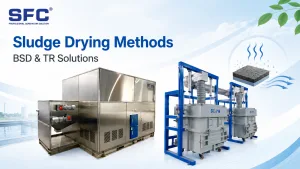
SFC’s BSD Series Belt Sludge Drying Machine uses a heat pump drying system and can dry dewatered sludge from around 80% moisture to below 30% under low-temperature drying conditions, according to SFC product information. The system is designed as a fully enclosed process with no odor overflow and can be modularly configured according to capacity requirements.
4. Reciprocating Circulation Sludge Drying
A reciprocating circulation sludge dryer uses circulating air and heat exchange to remove moisture from sludge in a closed drying process. This method is designed to reduce sludge volume while improving energy utilization.
SFC’s TR Series Reciprocating Circulation Sludge Dryer is designed to use a circulating air system and heat exchange process to remove moisture from sludge. SFC product information states that sludge can be reduced by up to 70% after drying, depending on sludge characteristics and operating conditions. The system also features integrated design, modular installation, easy operation, and PLC-based return-air temperature control.
How to Choose a Sludge Drying Method
There is no single drying method suitable for every project. Before selecting a sludge drying system, project engineers should review the following factors:
- Inlet sludge moisture content
- Daily sludge treatment capacity
- Target final moisture content
- Available energy source
- Site layout and installation space
- Odor and exhaust gas control requirements
- Operating hours
- Downstream disposal or resource recovery route
- Local environmental requirements
- Total lifecycle cost
For example, solar drying may be suitable when land is available and drying time is flexible. Low-temperature belt drying may be more suitable when enclosed operation, modular capacity, and stable output are required. Reciprocating circulation drying may be considered when the project needs integrated drying and volume reduction under controlled conditions.
SFC Sludge Drying Solutions
Shanghai Fuchan Machinery Technology Co., Ltd. (SFC) provides sludge drying equipment and integrated sludge treatment solutions for municipal and industrial wastewater projects. SFC’s drying equipment can be combined with sludge thickening, mechanical dewatering, high-pressure deep dewatering, polymer preparation, sludge conveying, and storage systems to build a complete sludge reduction process.
SFC’s sludge drying product range includes SFC-BSD Series Belt Sludge Drying Machine and SFC-TR Series Reciprocating Circulation Sludge Dryer. These systems can be selected according to sludge moisture, treatment capacity, site conditions, energy source, and final disposal requirements.
Conclusion
Sludge drying is an effective way to further reduce sludge volume after dewatering. By lowering moisture content, drying can help reduce transportation cost, storage pressure, and final disposal difficulty.
The best sludge drying method depends on actual project conditions. Thermal drying, solar drying, low-temperature belt drying, and reciprocating circulation drying each have different advantages and limitations. For municipal and industrial wastewater treatment plants, a suitable drying system should be selected based on sludge characteristics, energy conditions, target moisture, and long-term operating cost.